
Fremont County Recent Arrest Posts
Fremont County Sheriff Arrests and Jail Intakes is the official feed. It works like a rolling set of posts rather than a full live jail roster. Each card can carry a name, an arresting agency, a charge or warrant headline, and a brief narrative. Some add the arrest date, location, age, or gender. Others include a reference number or a photograph when the agency supplies one. It is not a fixed 24-hour arrest report.
Publication and custody are two different things here. An arrest date on a card can sit earlier than the CRIMEWATCH Created date. Someone may be processed, released, or even skipped from public posting entirely. The newest card is a lead, not proof of current custody. On the official FCSO portal, one shared publishing system handles everything. Arrest, warrant, case, incident, and news items all flow through it.
The interface helps identify the post type, though the agency and event date still deserve a check.
| Question | Official route | Window |
|---|---|---|
| What appeared newest? | Daily Arrest Report | Newest-first review, not a promised 24-hour dataset |
| What appeared over several days? | Weekly Arrest Log | Show more adds depth, but no weekly boundary is promised |
| Is one person in custody now? | VINELink Inmate Check | Current custody and alerts, subject to processing lag |
Who Was Arrested Most Recently?
For a same-day answer, open the newest FCSO post first. Compare its arrest date against the Created or Updated stamp. The source promises no hourly refresh, no maximum lag, and no complete overnight count. Is a fresh Fremont County arrest missing? Search the sheriff-linked VINELink system next. Then call Intake/Booking at 719-276-5555, option 2. That call is the official fallback for current bond and hold details. Records staff handle copies, not live jail status.
Fremont Arrest Alerts by App
The sheriff also pushes selected material through its CRIMEWATCH app and free portal notifications. Users can browse nearby crime and send anonymous tips. They can also read agency news and receive alerts drawn from the publishing system. A new public item is easier to spot that way. But the app is not a second arrest database. It does not promise an alert for every person booked into the Fremont County Detention Center.
Treat any notice as a path back to the official post itself. There, check the arrest date and the Created or Updated time. Also check the charge language and the agency. For live custody, use VINELink or call Intake/Booking. That split matters when a notification lands after release. It also matters before an intake ever becomes a public card.
Fremont County Arrest Custody Search
Fremont County offers no separate, verified roster of everyone currently held by the sheriff. Instead, the FCSO inmate-locator page sends custody searches to Colorado VINELink. It lists the Intake/Booking phone as backup. CRIMEWATCH plays a different role. A published arrest can stay visible long after release. Calling that list a live roster would blur a distinction that matters locally. The official inmate-locator page shows the custody route. It warns that public bond data can be incomplete or stale.
This page bridges a recent public arrest post and a present-custody check.
| Search item | Use and limit |
|---|---|
| Name or identifier | Use fields shown by the live interface; labels can change |
| Agency or facility | Confirm the match belongs to the relevant custody source |
| Custody status | Reflects data supplied to VINE, not a full arrest history |
| Notification | Registers for a custody-change alert when available |
| Photo | May appear when supplied, but is not guaranteed |
Run the name search first. Compare likely matches, and confirm the source facility. Register for alerts if a custody change matters to you. When a result is new, missing, or unclear, phone Intake/Booking. FCSO notes that bond hearings generally happen within 48 hours under C.R.S. § 16-4-102. A displayed amount may leave out another hold. Booking staff or the court confirm the current position.
Where Fremont Arrest Information Appears
No single Fremont County source tracks every stage. The arrest post shows what an agency published. VINELink handles current custody and alerts. The court follows the case, and CDOC takes over after a state corrections entry. Secondary directories and news reports rank last, since their items can be selective, copied, old, or simply gone.
| Channel | Photo? | Status | Best use |
|---|---|---|---|
| FCSO Arrests/Jail Intakes | Sometimes | Official | Recent public posts |
| Colorado VINELink | When supplied | Official service linked by FCSO | Custody and alerts |
| FCSO Records | By reviewed request | Official custodian | Booking record or photo |
| Colorado Judicial | No booking-photo function | Official | Docket and disposition |
| Local news | Selected stories | Unofficial reporting | Event context only |
| Mugshots.com archive | Older images | Unofficial and stale | Historical lead requiring verification |
| JailExchange / All Inmates | Varies | Unofficial directories | Secondary navigation |
Busted Newspaper carries no working Fremont page, and Recently Booked returns a removed route. Arrests.org lacks a verified local section. Mugshots.zone redirects away from its county route. Never let another county's material fill those gaps. The Cañon City Daily Record, KOAA, KRDO, and the Gazette cover selected cases. It is not a continuous roster. Even a story with an agency photo leaves the originating record and the court result in control.
Fremont Arrest Posts Can Change
Sheriff posts are not set in stone. The FCSO portal warns that its law-enforcement content can change. It gives readers a way to flag inaccurate information. That county-hosted arrest card is still the best window. It shows what the sheriff chose to publish about a Fremont County booking. It is simply not the last word. An Updated date on a post may signal a correction. Or it may mark a newly added detail rather than a rewrite from scratch.
Suppose a copied arrest post conflicts with the CRIMEWATCH original. Save the URLs and the dates first. Then verify the booking itself with FCSO and the case outcome with Fremont Combined Court. A correction on the official post may never reach every search index. It may never reach every news story or third-party copy floating around the web. Treat the source, the court record, and any lawful sealing order as three separate things.
Recent Fremont Arrests by City
Three city pages break Fremont arrests down by where they happened. Cañon City Recent Arrests covers Cañon City Police records. It also explains the department's daily crime-log policy and county detention. Florence Recent Arrests explains why Florence Police arrests run through FCSO. A municipal report route still exists. Williamsburg Recent Arrests tracks the town's official handoff to the sheriff and keeps town documents apart from county bookings.
All three roads can end at the Fremont County Detention Center once a person is accepted into county custody. Still, the arresting agency often keeps the incident report. The Fremont Combined Court holds whatever the case became. So read the agency field on each entry. A city name alone tells you little. It hides who made the arrest and where the person sits now.
What Fremont Arrest Records Show
A booking record is born at the jail door. The CRIMEWATCH card sits on top of it as a public communications layer, nothing more. Colorado law defines arrest and criminal-record information broadly. Identity and agency fit inside that definition. So do the arrest date and place, the offense, the formal charge, and the disposition. A records response can hold far more than a web card. Redactions, active-investigation rules, privacy limits, court orders, and sealed matters still apply.
| Field | Meaning and limit |
|---|---|
| Name and identifying details | The person recorded by the source; age or gender may appear |
| Arrest or booking date | Event or intake time, which can differ from publication time |
| Arresting agency | FCSO, CCPD, FPD, State Patrol, or another agency |
| Charge or warrant | The booked charge, not a conviction |
| Bond or hold | Published information that needs current confirmation |
| Reference and location | A case, docket, agency ID, or event place when supplied |
| Photo | An identifying image when posted; absence proves no more |
| Created or Updated | Public-post timing, not necessarily arrest timing |
Fremont County Mugshots and Photos
A booking photograph may show up on an individual arrest detail when FCSO supplies one. The sheriff promises no photo for every detainee. No timeline is given for when an image appears or comes down either. An empty image slot means only that nothing is displayed there. Ask FCSO Records directly for the booking photo. Name the municipal agency too if its police hold it.
The Colorado Department of Corrections offender locator is a separate photo source. It covers people held inside state corrections. It is not a fresh county-booking tool. State facilities sit around Cañon City, though. County pretrial custody, sheriff-remanded custody, and a CDOC sentence are three different statuses. The BOP locator shows no inmate photos. ICE custody gets searched through an entirely separate system of its own.
Third-party pages stay secondary. Mugshots.com's Fremont archive was real but stale. Other expected county routes were missing or redirected. A copied photo can outlive the official post and miss later corrections. Check the agency, the court disposition, and any sealing order before leaning on it.
Request a Fremont Booking Record
The FCSO Records Division is the formal route for a booking record or photo. The counter is open Monday through Thursday, 7:30 a.m. to 4:30 p.m., holidays excluded. Anything arriving after 3 p.m. or during a closure rolls to the next business day. Call 719-276-5521 or 719-276-5525, or write records@fremontso.com. Mail or deliver requests to Fremont County Sheriff's Office. Use Attn: Records, 100 Justice Center Road, Cañon City, CO 81212.
- Use and sign the written FCSO request form. Supply the requested state ID or driver's-license copy.
- Give the full name, approximate arrest date, agency, location, and known booking, case, or reference number.
- Name the item sought, such as a commitment entry, booking file, case report, or photograph.
- Wait for staff to confirm scope, redactions, availability, and the required prepayment.
- Answer clarification within ten business days and collect completed records within thirty days.
Timing comes in two flavors. FCSO states a three-business-day response effort, while most case reports are generally ready within fourteen working days after the incident report lands. Those are separate steps, not one delivery promise. For payment, the office takes cash, money orders, attorney checks, business or cashier checks, or credit card by phone with a transaction fee. Personal checks are turned away. Under C.R.S. § 24-72-306, the office may charge reasonable search, retrieval, and redaction costs, cap a standard page copy at $0.25, and bill actual cost for a photograph or other format. The official FCSO records page lays out the county request route and its operating details.
A narrow, specific request helps staff tell a detention booking apart from a police report or court file.
Colorado Arrest Photo and Sealing Law
Colorado draws its rules from the Criminal Justice Records Act, C.R.S. §§ 24-72-302 through 307, which splits official actions from other justice records. Custodians may redact or withhold material under a statute. A court order, active investigation, privacy need, or public-interest rule can also justify it. Section 24-72-307 builds in an accuracy-challenge route. The FCSO portal adds its own path for disputed public information.
Money and mugshots collide in C.R.S. § 24-72-305.5. The statute bars direct pecuniary solicitation of criminal-justice records. It also makes it unlawful to knowingly obtain a booking photo for a publication that charges for removal. A demand for cash to pull a booking image is a red flag. Save it and get legal or consumer advice. Mugshots.com describes a free contact and expungement-based process for its own Fremont archive. That is just the site's policy. It changes nothing about the official record or copies living elsewhere.
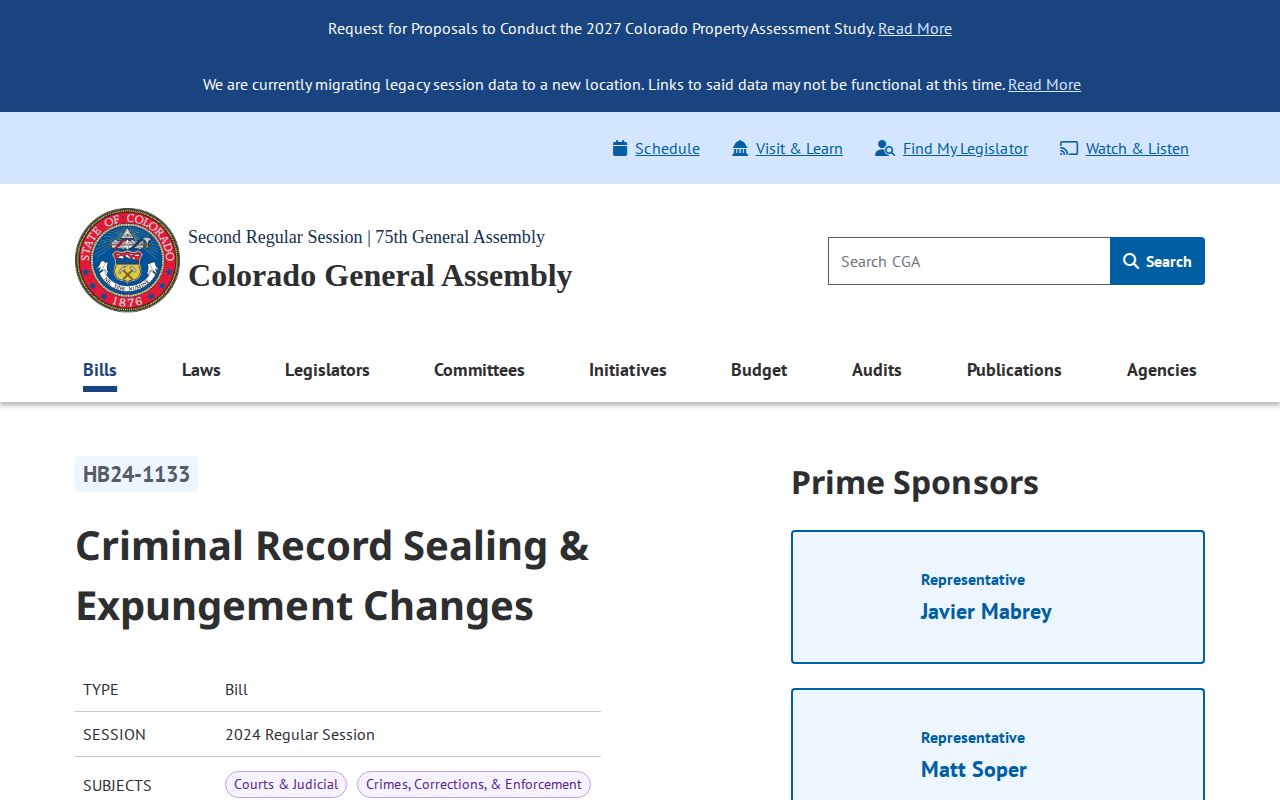
The official HB24-1133 page records the changes involving sealing and mistaken identity.
Filing starts with the current Judicial forms. Eligibility turns on the case, charge, dates, and result. The Colorado Judicial Seal My Case route walks through arrest, conviction, municipal, and juvenile processes. Sealing hides a record; it does not destroy it. Some arrests without charges seal automatically. HB24-1133 adds mistaken-identity and other procedures starting July 1, 2025. Serve a lawful order on each custodian and republisher, and once the source updates, Google's Remove Outdated Content tool may refresh a stale search result, though it cannot seal a live page.
When Fremont Records Leave the Feed
A CRIMEWATCH card that vanishes is not a deleted government record. Publication, retention, access, and indexing each follow their own rules. Fremont County's schedule makes the Daily Record of Jail Commitments and Discharges permanent. Other inmate files keep for periods set by record and case type. Redaction explains a change. So can correction, sealing, roll-off, or a technical fault. For a recent missing booking, ask FCSO. Request the commitment and discharge entry, the booking file, or the photo. Historical material may sit with the Colorado State Archives. Its finding aids cover Fremont Sheriff jail registers from 1922 through 1943 and criminal-process dockets from 1909 through 1946. Those are historic records, not a mugshot database. An entry does not promise a photograph. Court outcomes stay with Judicial, and old news images stay with publishers.
Fremont Warrants and Most Wanted
The FCSO Most Wanted and FCSO Warrants pages are the county's official routes. Listings show descriptors and active status. Warrant type, issuing authority, issue date, docket, location, narrative, and a photo appear too. No refresh schedule is posted. Neither a complete count, a universal reward, nor an archive appears. Each listing is a snapshot, so a missing name does not prove no warrant exists. The official warrant list page shows its format.
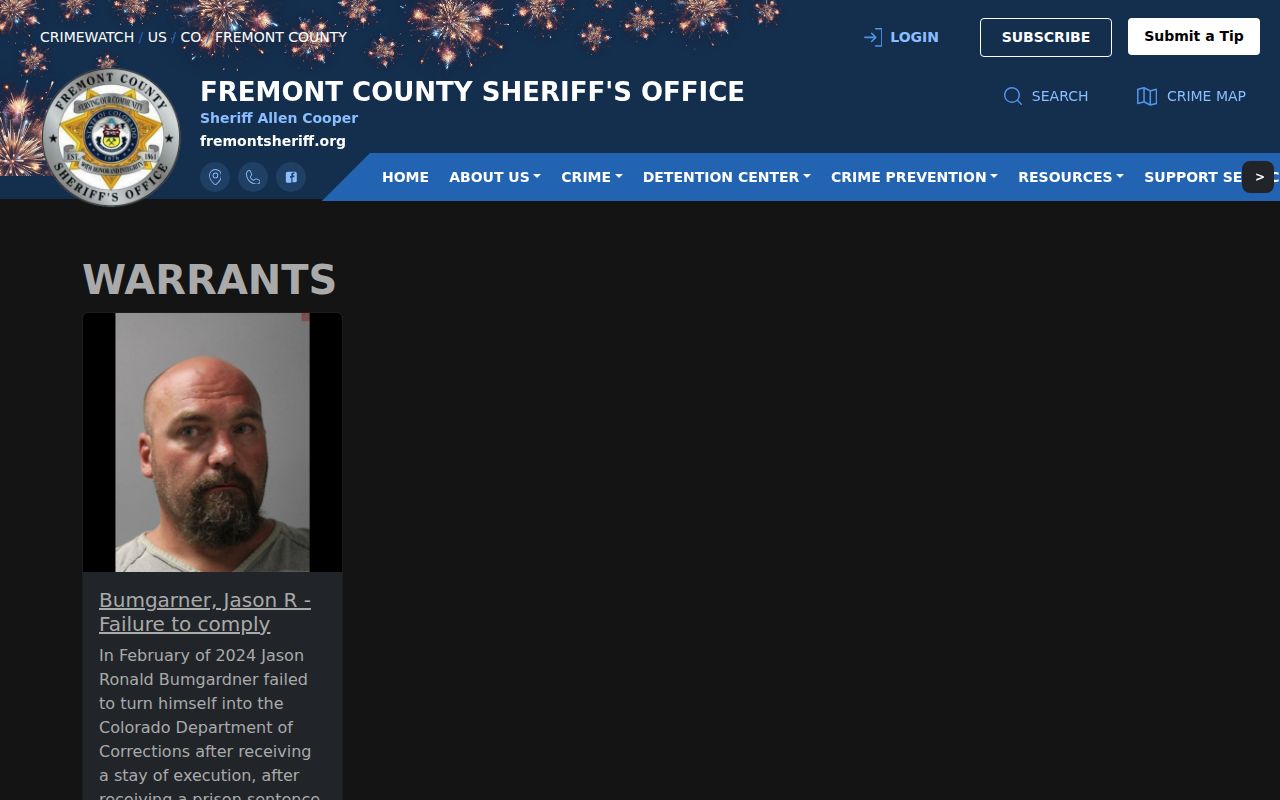
Warrants can be recalled, changed, or limited by jurisdiction. Confirm case status through the court and the sheriff. An affected person should contact an attorney or the court for lawful resolution. Never approach, follow, confront, or detain anyone listed. Send tips through the official FCSO tip form. Call 911 for immediate danger. A Crime Stoppers reward tied to one investigation does not cover every warrant. If a caller demands warrant payment, verify through published official numbers rather than the caller.
After a Fremont County Arrest
Booking opens the public record. The court disposition closes the case. Between those points, an arraignment addresses the charges and any plea. Bond is a release condition the court sets. It sometimes carries a financial requirement. The disposition is the formal outcome: dismissal, acquittal, deferred judgment, plea, or conviction. None of these matches the entry logged at jail intake. Use the Fremont docket search for scheduled proceedings and case events. Email FremontRecordsRequest@judicial.state.co.us for a complaint or register of action. The same address works for a disposition or sentence order. Court and sheriff sit near each other in the Justice Center area. Their records stay distinct. FCSO holds booking and incident material. The court holds case events and orders. A docket match needs more than a shared name. Sealed or restricted cases may not appear publicly.
County, State, and Federal Custody
The Fremont County Detention Center lists 240 beds. It accepts arrestees from local, state, and federal agencies in the county. That does not make it part of CDOC. A county detainee may await court or serve a sheriff-remanded sentence. State custody uses the Colorado Department of Corrections locator. A result may include an offender photo. Still, it is no fresh-booking feed and cannot replace the county route in the booking-photo section. The Federal Bureau of Prisons locator applies only after entry into BOP custody and publishes no inmate photographs. ICE keeps a separate detainee locator. The Marshals Service often houses federal pretrial prisoners in local or contract facilities and has no comparable public national locator. A federal agency on a county post does not establish later BOP custody. Search the right system and report what it returns.
- Booking
- The intake process after an arrest.
- Bond
- A court-set release condition that may coexist with other holds.
- Detainer
- A hold or request from another authority, not proof of conviction.
- Disposition
- The court's formal result, not the booked charge.
- Sealing
- A legal restriction on public access that does not destroy the file.
Missing Fremont Arrest Results
Juvenile matters and sealed or suppressed cases stay out of public searches. So do protected victim data and active investigations. Other restricted records do too. Absence proves nothing about whether an arrest happened. A gap can also mean a different custodian or a release before publication. Ordinary posting delay plays a role too. Never rebuild a withheld identity from news reports or old third-party material.
Fremont Calls Versus Arrest Records
The FCSO Citizen Connect map plots calls for service, locations, and trends. It answers a place-based question. A mapped call does not show an arrest. It names no detainee and supplies no booking photo. Person-level questions belong to the arrest feed, VINELink, agency records, and court files. Use Citizen Connect to understand activity near a place or follow sheriff alerts. Then CRIMEWATCH carries the arrest post. Custody routes show present status. Keeping the tools apart stops a service call from reading as a booking and a map point from attaching to the wrong person.
Fremont County Sheriff’s Office Location and Directions
Search Public Records
Sponsored Results